








































How to Determine Your Cleanroom ISO Classification and Calculate Air Changes per Hour (ACH)
How to Determine Your Cleanroom ISO Classification and Calculate Air Changes per Hour (ACH)
When designing a controlled environment, you cannot afford to guess. Under-designing a cleanroom leads to catastrophic contamination risks and failed FDA/ISO audits. Over-designing, on the other hand, spikes your upfront equipment costs and results in astronomical monthly energy bills.
To strike the perfect balance, cleanroom engineers rely on two fundamental metrics defined by the ISO 14644-1 standard: ISO Classification and Air Changes per Hour (ACH).
In this technical guide, we will walk you through how to choose the right cleanliness standard for your specific application and exactly how to calculate the airflow your HVAC system requires.
Understanding ISO 14644-1 Cleanroom Classifications
Cleanroom cleanliness is rated from ISO Class 1 (the cleanest) to ISO Class 9 (the least clean). The classification is determined by the maximum allowable concentration of particles per cubic meter of air.
For most industrial, pharmaceutical, and medical device applications, the sweet spot lies between ISO Class 5 and ISO Class 8.
| ISO Class | Federal Standard Equivalent | Common Industry Applications |
| ISO Class 5 | Class 10 | Sterile pharmaceutical compounding, semiconductor packaging |
| ISO Class 6 | Class 1,000 | Biotechnology, specialized medical device manufacturing |
| ISO Class 7 | Class 10,000 | Pharmacy compounding (USP 797), aerospace, electronics |
| ISO Class 8 | Class 100,000 | Medical device packaging, nutraceuticals, plastics molding |
What is Air Changes per Hour (ACH)?
Once you know your target ISO class, you must determine the Air Changes per Hour (ACH). ACH is the measure of how many times the total volume of air inside the cleanroom is completely replaced by filtered, conditioned air every 60 minutes.
Because cleaner rooms require faster particle removal, the recommended ACH ranges scale up drastically:
-
ISO Class 8: 10 to 25 air changes per hour
-
ISO Class 7: 30 to 60 air changes per hour
-
ISO Class 6: 90 to 180 air changes per hour
-
ISO Class 5: 240 to 480+ air changes per hour
Step-by-Step Cleanroom Airflow Calculation
To size your HVAC system and determine how many Fan Filter Units (FFUs) your modular cleanroom requires, you need to calculate the total Airflow Volume in Cubic Feet per Minute (CFM).
Follow this three-step formula used by cleanroom engineers worldwide.
Step 1: Calculate the Cleanroom Volume
First, find the total cubic volume of your proposed cleanroom space:
Volume = Length Width Height (in feet)
Step 2: Apply the ACH Formula
To find the required airflow in CFM, use the standard engineering formula:
CFM = (Volume ACH) / 60
Step 3: Determine the Number of FFUs Needed
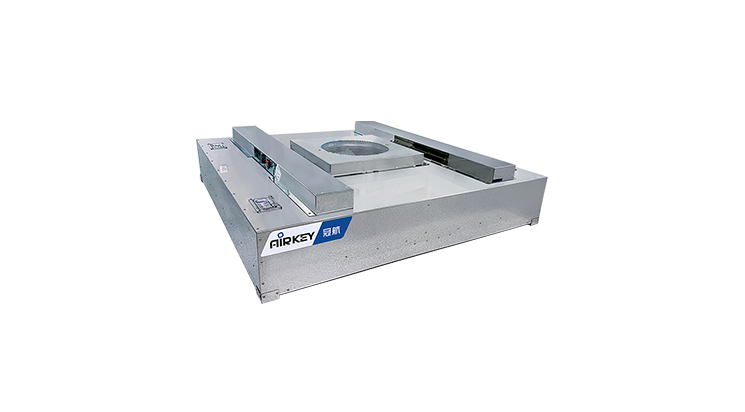
A standard 2*4 ft Fan Filter Unit typically delivers around 650 CFM of filtered air. To find out how many units your ceiling grid needs, use this final step:
Number of FFUs = Total Required CFM / 650
A Real-World Calculation Example
Lets say you are building an ISO Class 7 Medical Device Packaging Room that is $30\text{ ft}$ long, $20\text{ ft}$ wide, and has a $9\text{ ft}$ ceiling height. For ISO Class 7, we will target a standard mid-range of 60 ACH.
-
Calculate Volume:30 20 9 = 5,400 cubic feet.
-
Calculate Required CFM:CFM = (5,400 60) / 60 = 5,400 CFM.
-
Calculate Number of FFUs:Number of FFUs = 5,400 / 650 8.3
Therefore, your facility will require 9 Fan Filter Units distributed evenly across your modular ceiling grid to maintain strict ISO Class 7 compliance.
Streamline Your Cleanroom Design with Experts
While math provides a solid baseline, real-world variablessuch as the number of operators inside the room, heat-generating machinery, and material transfer frequenciescan significantly alter your required airflow.
At Airkey Envirotech Co., Ltd., we dont just supply precision-engineered modular wall panels and ceiling grids; we help you engineer the entire system. Our technical team ensures your cleanroom achieves perfect pressure cascades and air balance.